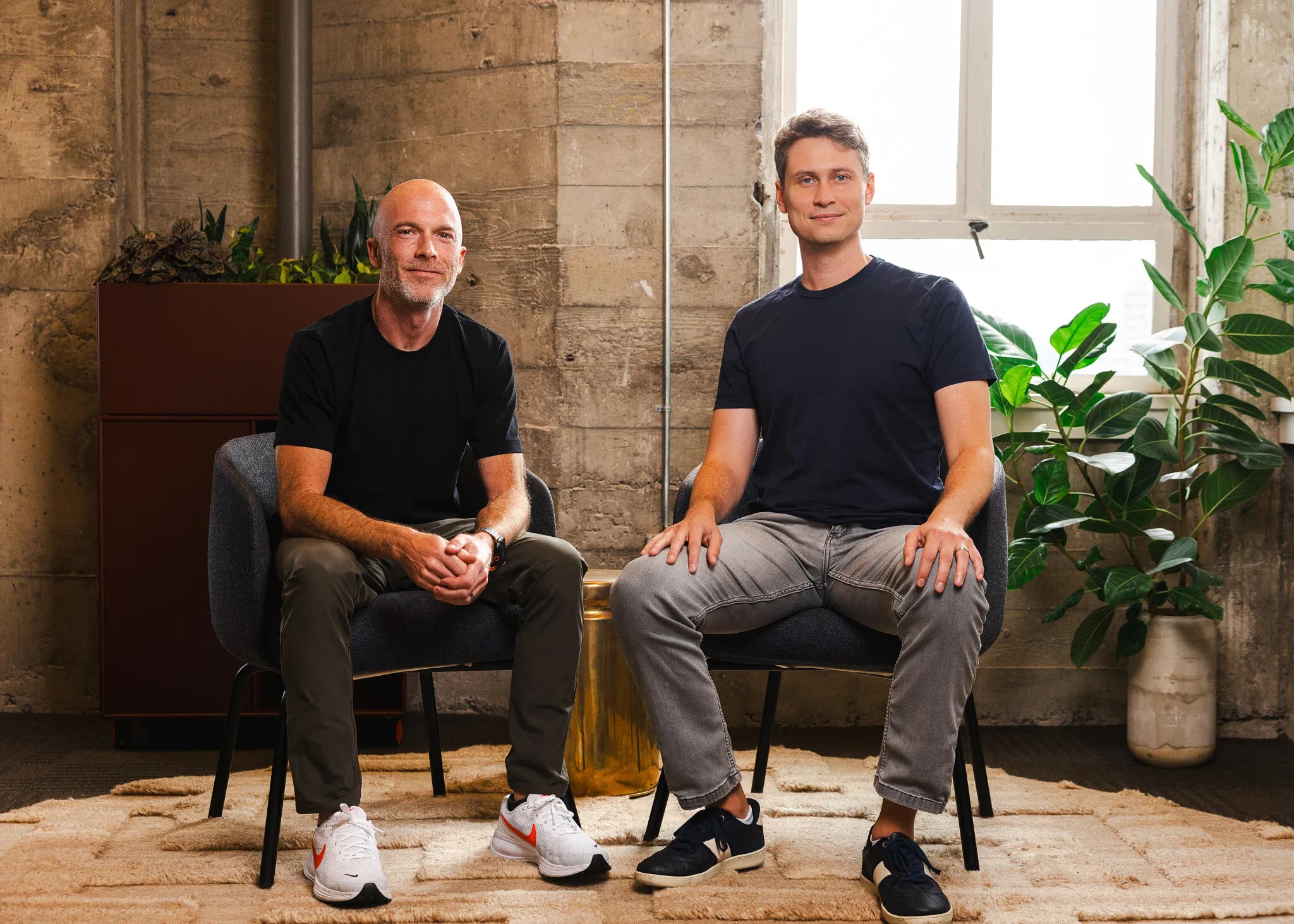

Thatch, the San Francisco-based employee benefits platform, has raised $108 million in Series C funding at a $1 billion valuation, officially joining the unicorn club. The round was led by General Partnership, Index Ventures, General Catalyst, and returning investor Andreessen Horowitz, with participation from ADP Ventures, Paychex, Eli Lilly and Company, Scale Venture Partners, QuantumLight, SemperVirens, Quiet Capital, and Avid Ventures.
The valuation represents a 2.4x jump from the $410 million Series B just 17 months ago—remarkable growth for a healthcare company without any AI hype narrative. The timing is strategic: Thatch closed funding just 12 days after the federal government rebranded the ICHRA (Individual Coverage Health Reimbursement Arrangement) regulation as the “CHOICE Arrangement,” effectively providing free national marketing for Thatch’s core business model.
Thatch Financials By CREDX Media
| Startup | Thatch |
|---|---|
| Founders | Chris Ellis, Adam Stevenson |
| Founded | October 2021 |
| Headquarters | San Francisco, USA |
| Latest Round (Series C) | $108M |
| Previous Valuation (Series B, April 2025) | $410M |
| Current Valuation | $1B |
| Valuation Growth | 2.4x in 17 months |
| Total Funding Raised | ~$193M |
| Annual Revenue Growth | 7x year-over-year |
| Paying Employers | 5,000+ |
| Employees | ~200 |
| Employee Coverage | 500,000+ employees covered via ICHRA |
| Series B (April 2025) | $40M |
| Business Model | ICHRA (CHOICE Arrangement) – Fixed budget per employee + marketplace choice |
| Category | Employee Benefits, HealthTech |
Startup Overview: Thatch
What Thatch Is Building in Simple Words
Thatch is fundamentally reimagining how employers provide health insurance by shifting control from HR departments to individual employees.
Here’s how it works:
1. Fixed Contribution Model
- Employer sets monthly budget per employee (e.g., $500/month)
- Instead of choosing one “company health plan” for everyone
2. Marketplace Shopping
- Employees browse dozens of health, dental, and vision plans
- AI recommends plans based on employee’s doctors, medications, and family situation
- Employees select coverage that matches their actual needs
3. Leftover Funds
- Any unused budget rolls to a Thatch debit card
- Can be spent on eligible healthcare expenses: GLP-1 prescriptions, Oura Ring, telehealth, fitness memberships
- Creates incentive for employees to seek cost-effective care
4. Distribution Partnerships
- Integrates with existing payroll systems (ADP, Paychex, Gusto, QuickBooks)
- Employers adopt without ripping out infrastructure
- Removes implementation friction
5. AI-Powered Recommendations
- Machine learning recommends optimal plan based on employee health profile
- Learns from actual employee behavior to improve recommendations
- Reduces decision paralysis for employees facing 50+ plan options
Why Thatch Matters
1. Healthcare Purchasing Is Broken Traditional employer-sponsored insurance treats all employees the same—one group plan, one deductible, one network. But a 25-year-old techie needs different coverage than a 55-year-old with diabetes. Thatch lets employees optimize for their actual needs.
2. Employer Costs Are Spiraling Employer health costs are projected to rise 8% in 2027—the sharpest jump since 2003. Companies are desperate for alternatives to renewing the same expensive group plan every year. Thatch’s fixed-budget model makes costs predictable.
3. Regulatory Tailwinds ICHRA was introduced in 2019 but remained relatively unknown. On September 3, 2026, the government rebranded it as the “CHOICE Arrangement” and launched a national awareness campaign. Nothing changed legally, but the federal government essentially marketing Thatch’s business model is extraordinary luck.
4. Market Adoption Is Accelerating 20,000+ US businesses now offer ICHRA, covering 500,000+ employees. That’s up from 12,700 employers in January 2025—a 58% increase in just 8 months. Adoption is doubling.
5. Revenue Validation at Scale With 5,000 employers on platform and 7x year-over-year revenue growth, Thatch isn’t theoretical. It’s a proven business model generating real recurring revenue from enterprise customers.
Our Take on Thatch
Thatch is rebuilding healthcare purchasing around the individual consumer instead of the employer HR function.
The strategic insight is borrowed from fintech and ecommerce playbooks: Amazon disrupted retail by centering the customer. Expedia disrupted travel by letting users book directly. Robinhood disrupted investing by removing friction. Thatch is applying the same logic to healthcare: why should employers pick health insurance for employees? Why not let employees pick for themselves?
The $1B valuation is justified on fundamentals: 7x ARR growth, 5,000 employers, regulatory tailwinds, and a clear path to profitability. Healthcare tech rarely commands premium valuations, but Thatch is solving a problem (employer cost predictability + employee choice) that both sides of the equation desperately want solved.
The real risk isn’t product—Thatch has demonstrated product-market fit. The real risk is regulatory: if the ACA’s individual market premiums rise faster than Thatch’s model assumes, employer interest could cool. For now, that risk is mitigated by rising employer group insurance costs and a federal rebrand that validates the ICHRA model.
Founder Background: From Cancer Research to Healthcare Reimagined
Chris Ellis (Founder & CEO) started his career as a cancer researcher at MIT, which provided deep understanding of how healthcare systems actually work. This wasn’t startup-founder-reading-about-healthcare-problems depth—this was lived experience working within medical institutions.
Ellis’ career trajectory reveals strategic moves: from MIT cancer research → Sophia Genetics (where he built US sales) → Agilent Technologies (product role). Each move built different expertise: scientific credibility, sales-market-fit, and product development. That combination is rare in founders and explains Thatch’s ability to navigate both regulatory and customer landscapes.
Speaking about Thatch’s vision, Ellis said:
“For too long, healthcare has been the one major purchase in someone’s life they never actually got to make. Give people control over their own healthcare dollars, and the first thing they do is ask what something actually costs.”
This quote reveals Thatch’s core positioning: healthcare transparency through choice.
Adam Stevenson (Co-Founder) brings operational and product engineering depth. Stevenson spent 4 years at Humana (one of the largest health insurers, understanding healthcare from the inside) followed by 7 years running engineering teams at Stripe (mastering payment infrastructure and scale).
This combination—Humana’s healthcare knowledge + Stripe’s technical scale—made Stevenson the ideal co-founder to build infrastructure that handles both regulatory complexity and payment volume.
The Regulatory Tailwind Nobody Expected
On September 3, 2026—12 days before Thatch’s Series C closed—the Centers for Medicare & Medicaid Services and Small Business Administration rebranded ICHRA as the “CHOICE Arrangement.”
Legally, nothing changed. The rules remained identical. But the rebrand came with a federal marketing push explaining the model to employers and employees. This is extraordinarily rare: a startup raising a $100M+ round and having the federal government announce a rebrand that directly supports its business model in the same month.
Jahanvi Sardana, partner at Index Ventures, articulated why this matters:
“Every massive consumer market eventually gets rebuilt around the individual—Amazon did it for retail, Expedia for travel, Robinhood for investing. With AI, the end state is bigger than shopping: an agent that knows you, holds your wallet and can find, book and pay for the right care.”
Sardana’s insight extends beyond healthcare: this is about matching the infrastructure to modern consumer expectations. Younger employees expect to choose, customize, and optimize their purchases in every domain. Healthcare is the last major consumer category where employers still make one-size-fits-all decisions.
Insights: Why Healthcare Adoption Accelerates at This Moment
The Competitive Landscape: Thatch as Category Leader
Gravie has raised the most capital ($463 million across all rounds) but focuses more on implementation and administrative complexity than consumer choice.
Remodel Health raised over $100 million (December 2024) after acquiring PeopleKeep, consolidating the space. But Remodel focuses on mid-market employers ($5M-$500M revenue). Thatch has distribution partnerships (ADP, Paychex) that reach smaller employers easier.
Take Command raised $25 million in Series B (2023), but has narrower focus than Thatch.
Smaller players had rougher outcomes: StretchDollar raised just $6M since 2024, and Venteur ($27M total) shut down operations in April 2026, transitioning all employers to Thatch. Venteur’s shutdown is significant—it validates Thatch’s platform as the industry standard.
Thatch’s advantages over competitors:
- Most capital ($193M total)
- Largest employer base (5,000+)
- Fastest growth (7x ARR)
- Strategic partnerships (ADP, Paychex, Eli Lilly, insurance carriers)
- First to achieve unicorn status in category
The 2027 Employer Cost Crisis
Employer health benefits are projected to rise 8% in 2027—the largest annual increase since 2003. This creates urgency for employers to find alternatives.
Traditional alternatives (high-deductible plans, narrower networks, increased cost-sharing) all result in employee dissatisfaction and recruitment/retention issues. Thatch’s model lets employees optimize within a fixed budget—employees feel empowered rather than penalized.
This fundamental difference (employee choice vs. employer cost-cutting) explains Thatch’s adoption acceleration.
The AI Hook (Without AI Hype)
Unlike companies that slap “AI-powered” to every feature for investor appeal, Thatch’s AI recommendations are genuinely valuable. Employees facing 50+ plan options experience decision paralysis. AI that says “based on your doctors and medications, Plan X is your best fit” solves a real problem.
The irony: Thatch’s business model doesn’t require breakthrough AI. Basic machine learning on healthcare purchasing patterns is sufficient. Yet the feature makes the product more compelling than what competitors offer.
Founder Intelligence: What Founders Can Learn from Thatch
1. Start with a Real Problem, Not a Funding Pitch
Ellis spent years in cancer research and healthcare. Stevenson worked at Humana. Their understanding of healthcare pain points came from direct experience, not reading TechCrunch. This domain expertise informed product decisions from day one.
Lesson: Deep domain expertise in your founder team compounds over time and helps navigate regulatory complexity.
2. Regulatory Tailwinds Are Real But Don’t Bet on Them
Thatch built a successful company before ICHRA was rebranded. The federal rebrand accelerated growth but didn’t create the category. Had the rebrand never happened, Thatch would still be on path to profitability.
Lesson: Build a business that works on fundamentals. Regulatory tailwinds amplify success but shouldn’t be your primary bet.
3. Distribution Partnerships Beat Direct Sales
Thatch integrated with ADP, Paychex, Gusto, and QuickBooks rather than hiring a large direct sales team. This let the company scale customer acquisition without massive headcount.
Lesson: In B2B, distribution partnerships are often cheaper and faster than direct sales. Find partners with aligned incentives.
4. Healthcare Tech Doesn’t Require AI Hype to Succeed
Thatch uses machine learning for recommendations, but it’s not marketed as “AI-powered healthcare revolution.” The company focuses on solving real employer and employee problems.
Lesson: Build products that solve genuine problems. Marketing hype amplifies good products but can’t carry bad ones.
Investor Intelligence: Why This Round Gets Premium Capital
The investor lineup reveals conviction: General Partnership (founded by Shasta Ventures alum), Index Ventures, General Catalyst, and A16z all returned for Series C. New investors include two large healthcare incumbents:
- Paychex – Major payroll and HR software provider. Strategic: Thatch integration improves Paychex’s benefits offering
- Eli Lilly – Pharmaceutical giant. Strategic: Thatch’s health data insights inform pharmaceutical purchasing patterns
- ADP Ventures – ADP’s corporate VC. Strategic: Partnership with Thatch embedded in ADP payroll infrastructure
Pharmaceutical and payroll incumbents investing in Thatch signals they view the company as an inevitable infrastructure layer, not a disruptive threat. They’re buying in rather than building competing products.
The Road Ahead for Thatch
Expansion Targets
With $108M in capital and proven product-market fit, Thatch will target:
- Employer base: 15,000-20,000 employers within 18 months (vs. current 5,000)
- Employee coverage: 1.5-2M employees covered via Thatch platform
- International expansion: ICHRA-equivalent regulations exist in other countries; test UK or Canada markets
- Vertical specialization: Develop healthcare AI agents for specific industries (tech, manufacturing, healthcare)
Product Roadmap (Expected)
- Healthcare AI agents – Book appointments, manage prescriptions, find providers autonomously
- Predictive health analytics – Recommend preventive care based on health profile
- Chronic disease management – Specialized tools for diabetes, heart disease, mental health
- Direct insurance partnerships – Negotiate rates directly instead of using ACA marketplace
- International compliance – Build international versions compliant with local regulations
Competitive Response
Expect:
- Traditional insurers (UnitedHealth, Humana, Aetna) to build competing products or acquire startups
- Payroll giants (ADP, Paychex) to deepen their own benefits offerings
- New startups to build vertical-specific solutions (tech-focused, healthcare-focused)
- AWS/Google potentially entering with healthcare marketplaces as add-ons to their enterprise offerings
Thatch’s moat: employer relationships + employee network effects + data on healthcare purchasing patterns.
Conclusion
Thatch’s $108 million Series C at $1 billion valuation represents validation that the healthcare purchasing model is shifting from employer control to employee choice. With 5,000 employers on platform, 7x year-over-year revenue growth, and regulatory tailwinds from the federal CHOICE Arrangement rebrand, Thatch has established itself as the category leader in employee-centric healthcare benefits.
The company’s ability to grow 7x revenue without relying on AI hype or disruption narratives suggests disciplined execution focused on customer value. Chris Ellis’ background in cancer research and Adam Stevenson’s experience at Humana and Stripe provided the domain expertise to navigate both regulatory complexity and healthcare infrastructure.
Whether Thatch can maintain its leadership as larger insurance companies and payroll providers build competing offerings remains an open question. For now, Thatch has capital, customers, and momentum. The next 18 months will determine whether it can scale to $1-2M employees and defend against inevitable competition from incumbents recognizing the strategic value of employee-centric healthcare marketplaces.
For deep analysis of healthcare technology funding, benefits innovation, and companies reshaping how employees access and pay for care, explore CREDX Media for comprehensive coverage of startup funding trends and founder intelligence.
Frequently Asked Questions
1. What exactly is Thatch and how does it work?
Thatch is a benefits platform that shifts healthcare purchasing from employers to employees. Instead of an employer selecting one group health plan for all employees, Thatch gives employers a fixed monthly budget per employee. Employees then shop a marketplace of health, dental, and vision plans and choose coverage that matches their actual needs. AI recommends optimal plans based on employee health profiles, and leftover funds can be spent on eligible healthcare expenses through a Thatch debit card.
2. How much did Thatch raise in Series C?
Thatch raised $108 million in Series C funding at a $1 billion valuation, led by General Partnership, Index Ventures, General Catalyst, and Andreessen Horowitz. New investors included ADP Ventures, Paychex, Eli Lilly and Company, Scale Venture Partners, QuantumLight, SemperVirens, Quiet Capital, and Avid Ventures. This brings Thatch’s total funding to approximately $193 million.
3. Who are Thatch’s founders?
Thatch was founded in October 2021 by Chris Ellis and Adam Stevenson. Ellis started his career as a cancer researcher at MIT, built US sales at Sophia Genetics, and worked in product at Agilent Technologies. Stevenson spent 4 years at Humana (a major health insurance company) and 7 years running engineering teams at Stripe before co-founding Thatch.
4. How much has Thatch’s valuation grown?
Thatch’s valuation grew from $410 million in April 2025 (Series B) to $1 billion in September 2026—a 2.4x increase in just 17 months. The company went from raising $40 million in Series B to raising $108 million in Series C, demonstrating accelerating investor confidence and business growth.
5. How many employers and employees does Thatch serve?
Thatch now serves 5,000+ paying employers covering over 500,000 employees with its ICHRA (CHOICE Arrangement) model. The company is growing at 7x year-over-year revenue, demonstrating rapid adoption in the employer benefits market.
6. What is ICHRA and why did the government rebrand it?
ICHRA stands for Individual Coverage Health Reimbursement Arrangement—a regulation introduced in 2019 that allows employers to give employees fixed healthcare budgets and let employees choose their own plans. On September 3, 2026, the Centers for Medicare & Medicaid Services and Small Business Administration rebranded ICHRA as the “CHOICE Arrangement” and launched a national awareness campaign. The legal rules didn’t change, but the rebrand essentially provided free marketing for Thatch’s core business model.
7. How does Thatch make money?
Thatch generates revenue by taking a percentage of the healthcare budgets employers allocate to employees. As employers increase their per-employee healthcare budgets or add more employees to the platform, Thatch’s revenue grows. The company also benefits from data on healthcare purchasing patterns, which creates additional monetization opportunities.
8. Who are Thatch’s main competitors?
Competitors include Gravie (raised $463M total), Remodel Health (acquired PeopleKeep after raising $100M+), Take Command ($25M Series B), StretchDollar ($6M raised since 2024), and others. Venteur, which had raised $27 million, shut down its platform in April 2026 and transitioned all employers to Thatch, validating Thatch as the category standard.
9. Why are employer healthcare costs rising so much in 2027?
Employer health benefits are projected to rise 8% in 2027, the largest annual increase since 2003. Rising medical costs, aging workforces, and increased healthcare utilization are driving the spike. Companies are desperately seeking alternatives to renewing expensive traditional group plans, making Thatch’s fixed-budget model increasingly attractive.
10. What does Thatch’s AI do?
Thatch uses machine learning to recommend optimal health plans for each employee based on their doctors, medications, family situation, and healthcare usage patterns. The AI reduces decision paralysis by analyzing 50+ plan options and suggesting the best fit. This makes the employee benefits selection process faster and more personalized than traditional methods.
Executive Discussion & Contributions
No executive dispatches on this briefing yet
Join the conversation above. Share your thesis, legal nuance, or empirical observations.