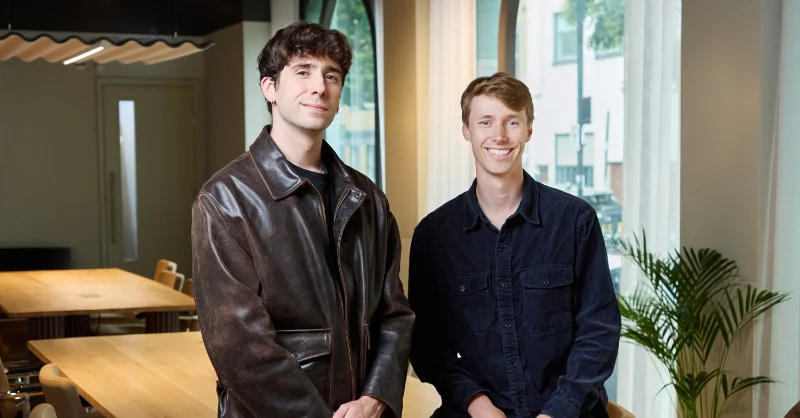

Magentic the London-based AI procurement platform, has raised $18 million in Series A funding led by Felicis with participation from existing investors Sequoia Capital and The Westly Group. The round brings Magentic’s total funding to $23.5 million in just 14 months since launch.
The funding represents a 3.3x increase from its $5.5 million seed round raised in July 2025—rapid investor conviction in agentic AI for industrial procurement. Magentic’s AI agents, called Mages, already process over one million purchase orders annually for a single manufacturer, operate across terabytes of procurement data, and have uncovered $4 million in savings that human teams overlooked.
Magentic Financials By CREDX Media
| Startup | Magentic |
|---|---|
| Founders | Robin Van Aeken, Odhran O’Donoghue |
| Founded | 2024 (launched July 2025) |
| Headquarters | London, UK |
| Latest Round (Series A) | $18M |
| Previous Round (Seed, July 2025) | $5.5M |
| Total Funding Raised | $23.5M |
| Time Between Rounds | 14 months |
| Lead Investor | Felicis |
| Existing Investors | Sequoia Capital, The Westly Group, First Momentum Ventures |
| Employees | ~17 |
| Business Model | AI agents for procurement and supply chain automation (B2B SaaS) |
| Category | AI Agents, Procurement, Supply Chain, Enterprise Software |
| Key Customers | Global 500 manufacturers, 3 of world’s 10 largest beverage producers |
Startup Overview: Magentic
What Magentic Is Building in Simple Words
Magentic builds AI agents that function as digital workers for procurement and supply chain teams at large manufacturers. Unlike traditional procurement software that requires human operation, Magentic’s agents operate autonomously inside existing tools—Microsoft Teams, email, and legacy internal systems—functioning more like team members than software.
Here’s how it works:
- Digital Workers (Mages)
- Multi-agent systems that operate inside a manufacturer’s existing software
- Communicate through Microsoft Teams and email just like human colleagues
- Handle end-to-end procurement workflows without requiring new interfaces
- Full Procurement Lifecycle
- Assess buy vs. build decisions
- Select and onboard suppliers
- Negotiate contracts and pricing
- Place purchase orders
- Process and reconcile invoices
- Direct and Indirect Spend Coverage
- Manages both indirect spending (services, supplies) and direct spend (raw materials)
- Addresses the hardest procurement categories that legacy software struggles with
- Handles billions of data rows across fragmented technology environments
- Enterprise-Grade Security
- Zero-data-retention agreements with leading AI model providers
- Deployable in any cloud environment
- Supports isolated installations in any data region
- Human-in-the-Loop Approval
- Critical decisions still require human approval
- Augments procurement teams rather than replacing them
- Company expects human teams to grow as individual output increases
Why Magentic Matters
- Procurement Is a Massive, Neglected Problem McKinsey estimates supplier compliance “leaks” amount to approximately 2% of total spending—$40 million on a $2 billion budget, according to Magentic’s research. Traditional procurement software captures data but doesn’t act on it. Magentic agents diagnose problems, plan fixes, and execute work across terabytes of multimodal data.
- The Physical Economy Is Entering Its Largest Capex Cycle AI-driven demand, trade disruption, and geopolitical challenges are forcing manufacturers to make higher-stakes procurement decisions faster. “The companies that build the best intelligence into every decision they make will be the ones that compound their competitive advantage,” said CEO Robin Van Aeken.
- Agentic AI Is Moving From Chat to Execution Magentic represents the shift from conversational AI to operational AI—agents that don’t just answer questions but take action inside enterprise systems. One manufacturer discovered $4 million in savings that human teams had overlooked.
- Customer Traction Validates the Model Magentic’s customers include Global 500 manufacturers and three of the world’s ten largest beverage producers. Typical savings range from 2% to 5%, with a 60% improvement in data quality. One customer processes over one million orders annually through Magentic’s agents.
- Investor Conviction Is Strong Felicis, which has backed 50+ unicorns including Shopify, Canva, and Notion, led the round. “Getting an agent to understand a manufacturer’s complex systems well enough to take action inside them is no small feat,” said Felicis partner Feyza Haskaraman.
Our Take on Magentic
Magentic is solving the least glamorous problem in enterprise software—procurement—and that’s precisely why it matters.
Supply chains decide what gets built and what doesn’t, yet they remain fragmented across email, spreadsheets, and legacy ERPs. Traditional procurement platforms record transactions but require humans to drive every step. Magentic’s agents diagnose, plan, and act autonomously, operating across gigabytes and terabytes of data that would overwhelm human teams.
The $18 million Series A is justified on multiple fronts: 14-month funding velocity (3.3x from seed), enterprise customer traction (Global 500 manufacturers), and a clear technical moat in handling complex, fragmented industrial data. The company’s approach—deploying agents inside existing workflows rather than forcing new interfaces—reduces adoption friction significantly.
The real risk isn’t technical feasibility—Magentic has demonstrated production-scale operations. The risk is enterprise trust: will procurement officers delegate contract negotiations and supplier selection to AI agents without human oversight? Magentic addresses this with human-in-the-loop approvals and zero-data-retention guarantees, but cultural adoption may lag technical capability. For now, early customers operating at scale suggest the market is ready.
Founder Background: How Oxford Hackathon Champions Built Magentic
Robin Van Aeken (CEO) and Odhran O’Donoghue (CTO) first met while winning hackathons at Oxford University. That competitive technical foundation evolved into Magentic after Van Aeken, a former McKinsey consultant, witnessed large manufacturers losing millions to supplier compliance failures.
Van Aeken spent years working with global manufacturers and identified procurement as a significant, underserved problem in enterprise software. His McKinsey background provided the domain expertise to understand where value leaks occur—and how to capture it. “The physical world is dealing with the biggest capex cycle in history, driven by AI demand, during a time of trade disruption and geopolitical challenges,” he said.
O’Donoghue, who holds a PhD in machine learning from Oxford and previously worked on AI projects at OpenAI, leads Magentic’s technical architecture. His vision: “Bringing frontier AI to the physical world requires pushing beyond AI systems with limited context windows. We’re building AI that can diagnose problems, plan the fixes, take action, and see work through across gigabytes and terabytes of multimodal data at once.”
The combination—McKinsey-trained domain expertise plus OpenAI-caliber technical execution—positions Magentic to navigate both enterprise procurement complexity and frontier AI challenges.
The Agentic AI Procurement Wave Nobody Expected
Magentic’s Series A comes as agentic AI procurement transitions from experimental to production-ready across the enterprise.
Coupa, the $10 trillion spend management platform, has deployed Navi agents across 450+ customers, achieving up to 50% reduction in requisition cycle times and 40% reduction in sourcing cycles. [Fairmarkit](https://www.fairmarkit.com/) launched Total Agentic Sourcing, handling autonomous procurement from $500 purchases to $500 million contracts. Ramp rolled out AI agents for procurement that save customers an average of 16% annually on vendor costs.
The competitive landscape validates Magentic’s thesis: procurement is the next frontier for agentic AI. But Magentic’s differentiation lies in physical-world complexity—handling direct materials, legacy ERPs, and the fragmented data environments that characterize industrial manufacturing.
Feyza Haskaraman of Felicis captured the opportunity: “Supply chains are the least glamorous part of the economy, yet the most consequential, deciding what gets built and what does not. That’s also what makes them so hard to automate.”
Insights: Why Procurement AI Accelerates at This Moment
The Competitive Landscape: Magentic’s Position
Coupa has the largest dataset ($10T+ spend) and public-market scale but focuses on indirect spend management. [Fairmarkit](https://www.fairmarkit.com/) handles autonomous sourcing from $500 to $500M contracts but lacks Magentic’s physical-economy depth. Ramp brings pricing benchmarks and SMB reach but serves a different customer segment. Magentic’s advantages:
- Physical economy focus — handles direct materials, not just indirect spend
- Legacy system compatibility — works with Excel and fragmented ERPs
- Enterprise security — zero-data-retention, isolated deployments
- Proven scale — 1M+ purchase orders annually for single customer
- Founder-market fit — McKinsey domain expertise + OpenAI technical depth
The Procurement Data Problem
Large manufacturers manage billions of data rows across disconnected systems. Traditional software captures this data but cannot act on it. Magentic’s agents ingest multimodal data at terabyte scale, diagnose inefficiencies, and execute corrective actions—capabilities that require architecture beyond standard LLM context windows.
The Human-AI Collaboration Model
Magentic doesn’t replace procurement teams—it augments them. Critical decisions require human approval, and the company expects headcount to grow as individual output increases. This collaborative model addresses enterprise trust concerns while delivering measurable savings: 2-5% typical, with one customer uncovering $4 million in overlooked savings.
Founder Intelligence: What Founders Can Learn from Magentic
- Domain expertise compounds: Van Aeken’s McKinsey years working with manufacturers identified where value leaks occur. That insight came from direct experience, not market research.
- Technical depth enables scale: O’Donoghue’s OpenAI background informed architecture decisions that handle terabytes of multimodal data—capabilities that generic AI solutions cannot match.
- Speed signals conviction: 14 months from seed to Series A, with 3.3x funding increase, demonstrates that investors reward rapid execution.
- Solve the unglamorous problem: Procurement isn’t fashionable, but it’s consequential. Magentic’s focus on physical economy workflows differentiates it from crowded enterprise AI markets.
Investor Intelligence: Why This Round Gets Premium Capital
The investor lineup reveals conviction: Felicis led the round after backing 50+ unicorns including Shopify, Canva, and Notion. Partner Feyza Haskaraman explained the conviction: “We haven’t seen anyone else build autonomous AI workers for the physical economy.”
Sequoia Capital and The Westly Group, both existing investors, returned for Series A—signaling continued confidence in Magentic’s trajectory. First Momentum Ventures, an early seed investor, also participated.
The investor composition matters: Felicis brings enterprise SaaS scaling expertise, Sequoia provides global network access, and The Westly Group contributes sustainability and industrial sector relationships. This syndicate positions Magentic for expansion into additional procurement and supply chain workflows.
The Road Ahead for Magentic
Expansion Targets
With $18M in capital and proven product-market fit, Magentic will target:
- Workflow expansion: Extend coverage to additional procurement and supply chain workflows
- AI research: Support long-term research into complex optimization problems
- Enterprise scaling: Deepen deployments across Global 500 manufacturers
- Geographic growth: Expand offices in London and New York
Product Roadmap (Expected)
- Larger context windows – Build AI systems handling even greater data volumes
- Multimodal processing – Improve data handling across gigabytes and terabytes
- Autonomous negotiation – Enhance agent capabilities for contract and pricing talks
- Specialized Mages – Develop agents for niche procurement categories
Competitive Response
Expect:
- Coupa, Fairmarkit, and Ramp to deepen agentic capabilities
- Traditional procurement platforms to acquire or build competing solutions
- New startups targeting vertical-specific procurement workflows
- Magentic’s moat: physical economy focus + legacy system compatibility + enterprise security
Conclusion
Magentic’s $18 million Series A at $23.5 million total funding validates agentic AI’s expansion into physical supply chains. The company’s 3.3x funding increase in 14 months reflects both technical execution and enterprise traction—1 million+ purchase orders annually, $4 million in discovered savings, and Global 500 customers.
Market tailwinds favor Magentic: the largest capex cycle in history, trade disruption, and procurement’s 2% spending leak problem. The company’s McKinsey-OpenAI founder combination positions it to capture this opportunity.
For deep analysis of AI agent funding, enterprise procurement innovation, and companies reshaping physical economy workflows, explore CREDX Media for comprehensive coverage of startup funding trends, valuation intelligence, and founder playbooks.
Want the latest funding news and market insights delivered straight to your inbox? Subscribe to CredX Letters—join venture capitalists, angel investors, founders, and corporate allocators who rely on CREDX Media’s newsletters for verified deal terms, valuation benchmarks, and daily macro signals. 100% free, zero spam, 1-click unsubscribe.
Frequently Asked Questions
1. What is Magentic’s total funding and latest round size?
Magentic has raised $23.5 million in total funding across two rounds. Its $18 million Series A was led by Felicis in September 2026, following a $5.5 million seed round in July 2025.
2. How much did Magentic raise in its Series A round and who led the investment?
Magentic raised $18 million in Series A funding led by Felicis, with participation from existing investors Sequoia Capital and The Westly Group, plus First Momentum Ventures.
3. What was Magentic’s seed round size and how did the Series A compare?
Magentic raised $5.5 million in seed funding in July 2025, making the $18 million Series A a 3.3x increase in round size just 14 months later.
4. How much total funding has Magentic raised since its founding?
Magentic has raised $23.5 million total across its seed and Series A rounds since launching in July 2025, with backing from Felicis, Sequoia Capital, and The Westly Group.
5. Who are the major investors in Magentic’s funding rounds?
Major investors include Felicis (Series A lead), Sequoia Capital, The Westly Group, and First Momentum Ventures, along with angels from SAP, Airbus, McKinsey, and Hugging Face.
6. What traction justifies Magentic’s Series A funding?
Magentic’s AI agents process over one million purchase orders annually for a single manufacturer and have uncovered $4 million in savings that human procurement teams overlooked.
7. How does Magentic generate revenue and what is its business model?
Magentic operates a B2B SaaS model, charging enterprise manufacturers for AI agents that automate procurement and supply chain workflows, with typical customer savings ranging from 2% to 5%.
8. What is Magentic’s competitive differentiation in the procurement AI market?
Magentic focuses on the physical economy—handling direct materials and legacy ERPs at terabyte scale—unlike competitors such as Coupa and Ramp that focus primarily on indirect spend or SMB markets.
9. What are Magentic’s plans for the $18 million Series A capital?
Magentic will extend coverage to more procurement and supply chain workflows, support long-term AI research into complex optimization problems, and scale enterprise deployments across Global 500 manufacturers.
10. How does Magentic’s AI agent technology work for enterprise procurement?
Magentic’s Mages are multi-agent systems that operate inside Microsoft Teams, email, and legacy systems to diagnose problems, plan fixes, and execute procurement tasks across terabytes of multimodal data.
11. What is the valuation of Magentic?
Magentic’s exact post-money valuation has not been publicly disclosed, but its $23.5 million total funding and 3.3x round-size increase position it as a fast-growing early-stage AI procurement startup.
Executive Discussion & Contributions
No executive dispatches on this briefing yet
Join the conversation above. Share your thesis, legal nuance, or empirical observations.