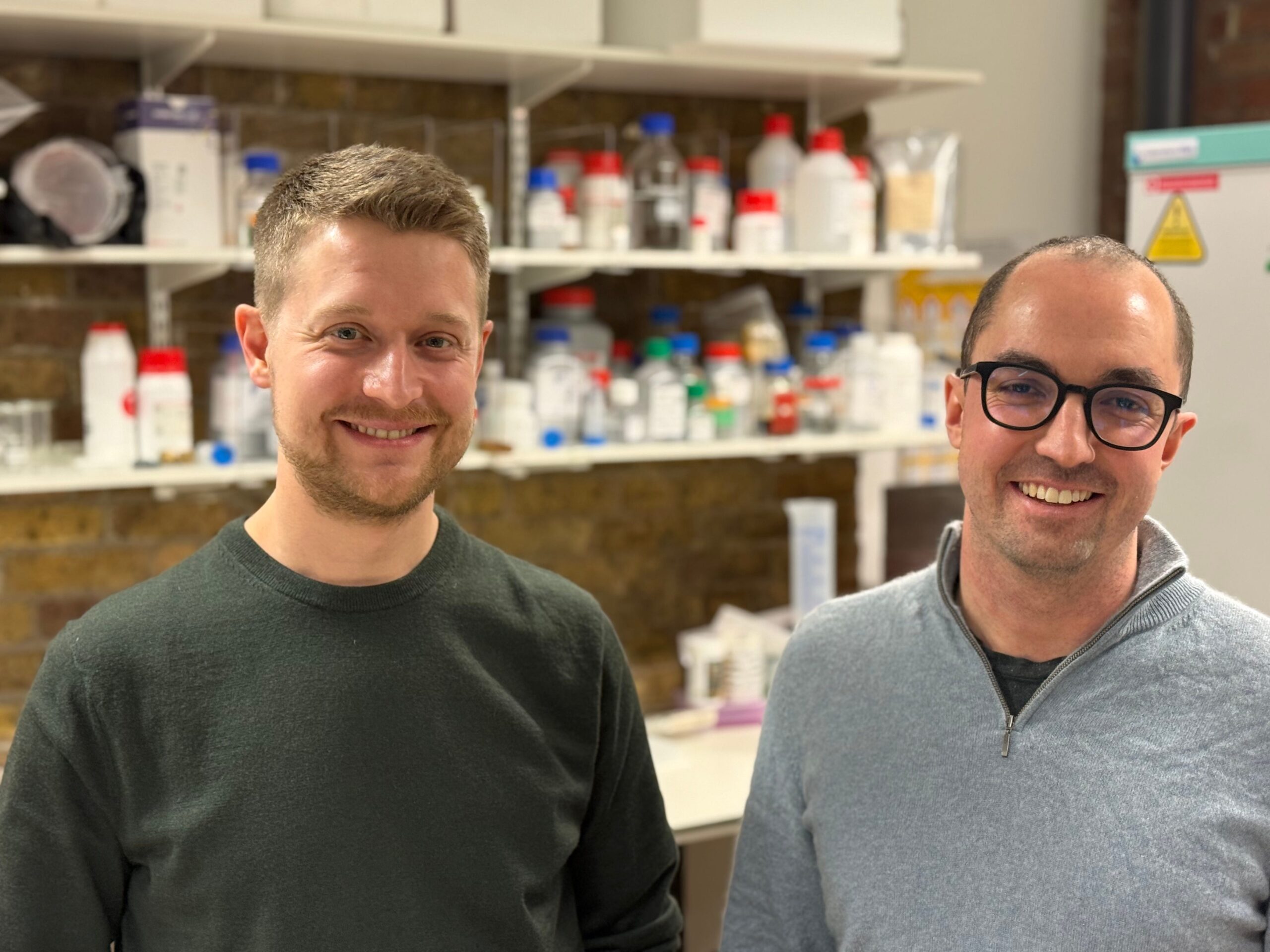
Basecamp Research, the London-based AI drug developer, has raised $140 million in Series C funding at an $800 million valuation—more than triple its last known valuation. The oversubscribed round was led by S32, with participation from NVIDIA, Anthropic’s Anthology Fund, Catalio Capital Management, the NATO Innovation Fund, and the Rockefeller Foundation.
The round brings Basecamp’s total funding to approximately $225 million, following a $60 million Series B in October 2024 and a $20 million Series A in December 2022.
Basecamp Research Funding & Valuation By CREDX Media
| Startup | Basecamp Research |
|---|---|
| Founders | Glen Gowers, Oliver Vince |
| Founded | 2019 |
| Headquarters | London, UK |
| Funding Rouund | Series C |
| Latest Round Funding | $140M |
| Current Valuation | $800M |
| Previous Valuation | ~$267M (implied) |
| Valuation Growth | ~3x |
| Total Funding Raised | ~$225M |
| Lead Investor | S32 |
| Key Investors | NVIDIA, Anthropic’s Anthology Fund, NATO Innovation Fund, Rockefeller Foundation |
| Business Model | AI-designed therapeutics (drug development) |
| Category | AI Drug Discovery, Biotech, Foundation Models |
Startup Overview: Basecamp Research
What Basecamp Research Is Building in Simple Words
Basecamp Research builds AI that designs medicines—specifically, cell therapies that reprogram a patient’s cells inside the body. Its core technology is EDEN, a biological foundation model trained on the Trillion Gene Atlas, the world’s largest proprietary genomic dataset.
- Trillion Gene Atlas: Proprietary genomic dataset collected through partnerships in 30+ countries, built with NVIDIA, Anthropic, PacBio, and Ultima Genomics
- EDEN Foundation Models: Biological AI trained on the Atlas that designs long, complex DNA sequences and generates therapeutic candidates directly
- In Vivo Cell Therapy: Reprograms patient’s cells inside the body, avoiding expensive ex vivo manufacturing, targeting cancer, autoimmune diseases, and genetic disorders
- DNA Writing Technology: Pairs EDEN-designed sequences with serine recombinases to insert DNA without double-strand breaks, achieving 63.2% functional hit rate in preclinical tests
- Pharmaceutical Partnerships: Appointed Richard Pearce (ex-Biogen) as Chief Business Officer, seeking co-development and licensing deals, with EDEN integrated into Anthropic’s Claude Science platform
- Why It Matters: CEO Glen Gowers says biology lacks internet-scale data—Basecamp is building that missing layer while NVIDIA and Anthropic partner on the platform
Startup Story: From an Icelandic Ice Cap to an $800M Valuation
Basecamp Research didn’t start in a lab. It started on a glacier.
Glen Gowers and Oliver Vince met at Oxford University and decided to retrace a 1932 ski route across Iceland’s Vatnajökull ice cap. Along the way, they performed the first fully off-grid DNA sequencing operation—proving they could collect and analyze biological data anywhere on Earth.
That expedition became the blueprint for the company. Since founding Basecamp in 2019, the team has conducted approximately 150 expeditions worldwide—from volcanoes to ocean depths to the high Arctic—building the Trillion Gene Atlas one sample at a time.
The insight was simple: AI models are only as good as their training data, and biology’s most valuable genetic information sits in places no one has sequenced. By going where others wouldn’t, Basecamp built a data moat that cannot be easily replicated.
That moat attracted NVIDIA, Anthropic, and S32—investors who understand that in AI, proprietary data is the ultimate competitive advantage.
Our Take on Basecamp Research
Basecamp Research is solving the fundamental data bottleneck in AI drug discovery—and doing it with backing from the companies that build the most advanced AI systems.
The $800 million valuation is justified on multiple fronts: 3x valuation growth from Series B, strategic partnerships with NVIDIA and Anthropic, and a differentiated approach that combines proprietary biological data with frontier AI models.
The real risk isn’t technical feasibility—the company has demonstrated strong preclinical results. The risk is clinical validation. Basecamp has six disclosed programs but none have reached human trials. Competitors like Chai Discovery ($3.8B valuation) and Isomorphic Labs ($2.1B raised) are also well-funded.
For now, the funding gives Basecamp room to advance its pipeline and secure pharma partnerships before larger competitors close the gap.
Founder Background: Oxford Graduates Who Sequenced DNA on an Ice Cap
Glen Gowers and Oliver Vince met while studying at Oxford University. Their origin story is a ski expedition retracing a 1932 route across Iceland’s Vatnajökull ice cap, where they performed the first fully off-grid DNA sequencing operation.
Gowers holds a PhD in synthetic biology from Imperial College London. The company has since conducted approximately 150 expeditions worldwide—from ice caps to volcanoes to ocean depths—collecting biological samples for the Trillion Gene Atlas.
The AI Drug Discovery Wave Nobody Expected
Basecamp’s Series C comes as AI drug discovery transitions from research tool to clinical pipeline.
Chai Discovery closed a $400 million Series C in July at a $3.8 billion valuation. Isomorphic Labs, the Google DeepMind spinout led by Demis Hassabis, raised $2.1 billion in May. The AI drug discovery market is projected to grow from $5.09 billion in 2026 to $17.56 billion by 2031.
Basecamp’s differentiation lies in its data strategy. While competitors focus on molecular prediction, Basecamp owns a proprietary genomic dataset collected through physical expeditions. This creates a data moat that cannot be easily replicated.
Founder Intelligence: What Founders Can Learn from Basecamp
- Build the data layer competitors can’t replicate: Basecamp’s Trillion Gene Atlas required years of expeditions and partnerships. This creates durable advantage.
- Align with strategic investors: NVIDIA and Anthropic invested because they’re partners. Choose investors who bring more than capital.
- Solve the expensive problem: Cell therapy manufacturing costs hundreds of thousands per patient. Basecamp targets the cost structure, not just the science.
- Go where others won’t: Ice caps, volcanoes, ocean depths. The willingness to do physical work creates digital advantage.
Investor Intelligence: Why This Round Gets Premium Capital
S32, founded by Bill Maris (founder of GV, Alphabet’s venture arm), led the round. Andy Conrad, General Partner at S32 and former CEO of Google’s Verily, joins the board.
NVIDIA and Anthropic’s Anthology Fund participated as strategic investors—both are partners in building the Trillion Gene Atlas and EDEN models.
The investor composition signals conviction: S32 brings life sciences expertise, NVIDIA provides compute infrastructure, Anthropic contributes frontier AI capabilities, and the NATO Innovation Fund adds institutional credibility.
The Road Ahead for Basecamp Research
Expansion Targets
With $140M in capital, Basecamp will:
- Train next-generation EDEN models
- Advance pipeline toward clinical development
- Expand pharmaceutical partnerships
- Conduct expeditions in Oceania and the high Arctic
Competitive Response
Expect:
- Chai Discovery and Isomorphic Labs to deepen pipelines
- Traditional pharma to acquire or partner with AI drug developers
- New startups targeting specific therapeutic modalities
- Basecamp’s moat: proprietary genomic data + DNA-writing technology + strategic AI partnerships
Conclusion
Basecamp Research’s $140 million Series C at $800 million valuation validates AI-designed therapeutics as a serious path to clinical development. The company’s 3x valuation growth reflects both technical progress and strategic partnerships with NVIDIA and Anthropic.
Market tailwinds favor Basecamp: the AI drug discovery market is growing 28% annually, cell therapy costs are unsustainable, and pharma needs new approaches. The company’s proprietary data moat and DNA-writing technology position it to capture this opportunity.
For deep analysis of AI drug discovery funding, biotech innovation, and companies reshaping therapeutic development, explore CREDX Media for comprehensive coverage of startup funding trends, valuation intelligence, and founder playbooks.
Want the latest funding news and market insights delivered straight to your inbox? Subscribe to CredX Letters for verified deal terms, valuation benchmarks, and daily macro signals.
Frequently Asked Questions
1. What is Basecamp Research’s valuation?
Basecamp Research is valued at $800 million following its $140 million Series C round in September 2026.
2. How much did Basecamp Research raise in Series C?
Basecamp Research raised $140 million in Series C funding led by S32, with participation from NVIDIA, Anthropic’s Anthology Fund, and others.
3. How much total funding has Basecamp Research raised?
Basecamp Research has raised approximately $225 million total across Series A ($20M), Series B ($60M), and Series C ($140M).
4. Who are the major investors in Basecamp Research?
Major investors include S32 (lead), NVIDIA, Anthropic’s Anthology Fund, NATO Innovation Fund, Rockefeller Foundation, Catalio Capital Management, and Singular.
5. How fast did Basecamp Research’s valuation grow?
Basecamp Research’s valuation grew approximately 3x from its Series B to Series C, reaching $800 million.
6. What was Basecamp Research’s Series B round?
Basecamp Research raised $60 million in Series B in October 2024, led by Singular.
7. Who are Basecamp Research’s founders?
Basecamp Research was founded in 2019 by Glen Gowers (CEO) and Oliver Vince, who met at Oxford University and performed the first off-grid DNA sequencing on Iceland’s Vatnajökull ice cap.
8. What is Basecamp Research’s business model?
Basecamp Research is developing AI-designed therapeutics, beginning with in vivo cell therapy, with plans for pharmaceutical partnerships and licensing deals.
9. What is EDEN and how does it work?
EDEN is Basecamp’s biological foundation model trained on the Trillion Gene Atlas that designs long DNA sequences and therapeutic candidates directly from disease information.
10. How does Basecamp Research’s technology differ from competitors?
Basecamp owns proprietary genomic data collected through global expeditions, unlike competitors focused on molecular prediction using public datasets.
Executive Discussion & Contributions
No executive dispatches on this briefing yet
Join the conversation above. Share your thesis, legal nuance, or empirical observations.